I’ve been experimenting with Pinterest for Left Field recently, and after three weeks of consistently publishing, my account has gone from essentially nothing to around 4K monthly impressions.
Small fry, but I’m pleased with this progress.
It’s important to put that number into context: three weeks is very early days on Pinterest. I don’t have a huge audience. Individual Pins are still getting fairly modest numbers of views. I certainly haven’t cracked the Pinterest algorithm and discovered the secret formula for turning a handful of Pins into a six-figure business.
What I do have is the beginning of some useful data.
And that’s what makes Pinterest interesting.
Pinterest isn’t really a social media platform
I think one of the biggest mistakes businesses make with Pinterest is treating it like Instagram.
You create a piece of content, publish it, see how many people engage with it and decide whether it worked.
That makes sense on a social platform where the majority of your content is being shown to people who already follow you, or being pushed into a feed based on their behaviour.
Pinterest works differently.
People go there to search for things.
They search for interior inspiration, recipes, travel ideas, wedding planning, outfits, business advice, home renovations, gifts, hairstyles, garden ideas and approximately 400 different ways to organise their lives.
The content they find doesn’t necessarily come from an account they follow. It comes from the platform matching their search with content it thinks will be useful.
That makes Pinterest much closer to a visual search engine than a traditional social network. Pinterest pins are also much more evergreen than anything you post on Instagram.
And that distinction changes how you should approach it.
Stop asking what you should post. Start asking what people are searching for.
If you’re creating content for Instagram, the question might be:
What should I post this week?
On Pinterest, I’d start with:
What might my potential customer search for?
That’s a much more useful question.
For example, if you’re a freelance copywriter, you could publish a Pin promoting a blog called “10 Freelance Side Quests to Strengthen Your Finances”. (But don’t, because I published that last week).
Or you could think about all the different things someone might actually type into Pinterest that could lead them towards that article.
They might search for freelance income ideas, ways to make more money as a freelancer, freelance finance tips, how to diversify freelance income, financial goals for freelancers or ways to earn more without taking on more clients.
Those are all potential search journeys into the same piece of content.
This is why Pinterest can be particularly useful for businesses that already have a decent library of content. A single blog post doesn’t necessarily have to produce one Pin. It can give you several different ways into the same subject, each targeting a slightly different search.
You’re not just creating social posts.
You’re building a searchable content library.
Which brings me to the numbers
This is where I think Pinterest can feel particularly frustrating when you first start using it.
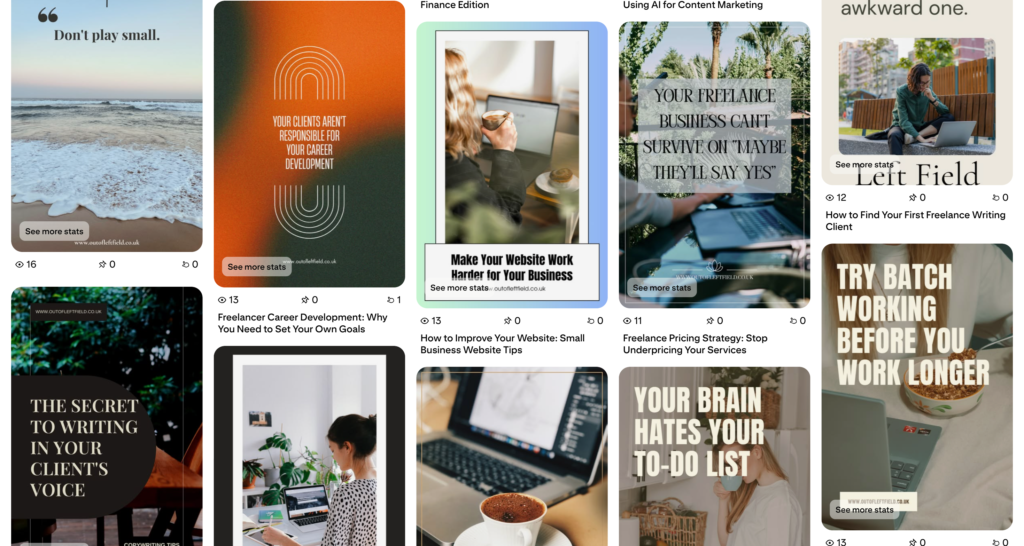
You might spend an hour making a Pin you really like and get 17 views.
It is very tempting to look at that number and decide the Pin didn’t work.
But what does 17 views actually tell you?
Very little.
You have one piece of content, published once, into a huge search ecosystem, with an account that is still establishing itself.
It’s one data point.
If you publish 50 Pins, you have 50 data points. If you publish 200, you have considerably more information to work with.
You can start to see which subjects get impressions, which keywords seem to help with discovery, which formats people save, which Pins generate outbound clicks and which topics consistently disappear without a trace.
That doesn’t mean you should churn out hundreds of mediocre Pins for the sake of it. Quantity without relevance isn’t a strategy.
It means that you need enough content for patterns to emerge.
That’s why I think Pinterest is a numbers game.
Not because more content automatically equals more success, but because you can’t learn much from a handful of observations.
My 4,500 monthly views aren’t a success story yet
This is something I’m deliberately keeping in mind with my own account.
Going from essentially zero to around 4,500 monthly views in three weeks is encouraging. It suggests that the account is beginning to get discovered, and that consistently publishing useful, relevant content is doing something.
But I wouldn’t use it as evidence that Pinterest is going to generate thousands of website visitors or leads for every business that follows the same process.
It would be far too early to say that.
At this stage, I’m interested in what happens next.
Which Pins continue to gather views after the initial publication period? Which topics get picked up in search? Which ones drive people through to the Left Field blog? How many of those visitors get in touch or join my mailing list? Which content earns saves? Which keywords appear repeatedly in the things that perform best?
That’s the useful stuff.
Because eventually, the aim isn’t to have a Pinterest account with a nice-looking monthly views number. Click through rate from Pinterest is around 1%. So at 4.5K monthly views, you’re only looking at around 45 clicks. But scale that up to 500,000 views, and that’s 5,000 clicks.
The aim is to have Pinterest contribute to something that actually matters to the business: website traffic, email subscribers, enquiries, sales or whatever your particular conversion point happens to be.
You don’t need a huge following
This is another reason I think Pinterest is worth looking at if you’re a small business.
You don’t need to build a massive personal brand before your content has any chance of being discovered.
Pinterest says that the vast majority of its searches are unbranded, meaning people aren’t necessarily searching for particular companies or creators. They’re searching for ideas, products, information and inspiration.
That’s quite a useful distinction.
Someone doesn’t have to know who Left Field is to search for freelance copywriting advice and find one of my Pins.
They don’t have to follow me.
They don’t have to know my name.
They just need to be looking for something I’ve created content about.
That’s a very different proposition from trying to persuade someone to follow yet another business account on Instagram.
It also means you need to stop judging individual Pins quite so harshly
Pinterest content has a longer lifespan than a typical social post, which is one of the things I like most about it.
A Pin doesn’t necessarily have to succeed on the day you publish it. It can be discovered later through search, related content or someone’s recommendations. A successful pin compounds, staying relevant and driving high-intent traffic to your website for months and years to come.
So I’m trying not to get too attached to the performance of individual Pins.
Some will do well. Some won’t. Some might start doing something interesting weeks or months after publication.
That’s useful because it takes some of the pressure out of the “I need to create something brilliant today” mentality that can make social media so exhausting.
The job is less about producing a constant stream of content that demands immediate attention and more about steadily building a collection of useful things that people can discover.
Think of your Pinterest account as a library
This is probably the simplest way I can explain the difference.
Your Instagram account is largely a feed. The newest thing is generally the thing people see.
Your Pinterest account is more like a library.
You want a useful collection of things that people can discover when they need them.
That means your old content doesn’t necessarily become irrelevant just because you published it six months ago. If the subject is still useful and people are still searching for it, there’s still an opportunity for that content to be found.
And the more useful content you have, the more potential entry points there are into your business.
That’s particularly interesting if you’ve spent years creating blog posts, guides, resources, product pages or other evergreen content that currently sits quietly on your website.
You may already have the raw material.
You just haven’t necessarily given Pinterest enough ways to find it.
So what should you actually be measuring?
Followers are probably the least interesting number to obsess over at the beginning.
I’d be looking at monthly views, yes, but also outbound clicks, saves, your best-performing Pins, the subjects those Pins cover and, most importantly, whether Pinterest is sending people somewhere useful.
The question isn’t really, “Did this Pin get lots of views?”
It’s, “What did this Pin tell me?”
If one topic consistently gets more discovery than another, that’s useful.
If several Pins around a particular search term perform well, that’s useful.
If people are seeing your content but nobody is clicking through to your website, that’s useful too. It might tell you that your Pins are doing their job as content but not giving people enough reason to continue the journey.
The numbers aren’t there to make you feel good about your Pinterest account.
They’re there to help you make better decisions about what you create next.
Three weeks in, I’m still learning
So, yes: 4,500 monthly views after three weeks is a nice little milestone.
But I’m much more interested in what happens after three months.
And six months.
And what I learn along the way.
That’s the bit I think gets lost when people talk about Pinterest growth. There is a tendency to look for a magic number of Pins, a magic posting schedule or a magic formula that will suddenly make everything take off.
I’m much more interested in treating it like any other search-based content strategy.
Research what people are looking for. Create something genuinely useful. Make it easy for Pinterest to understand what it’s about. Publish consistently. Pay attention to the data. Create more of the things that show promise. Give it enough time to work.
In other words, stop treating Pinterest like a social media account you need to keep alive and start treating it like a search engine you’re building a presence in.
You don’t need every Pin to be a hit.
You need enough useful content, over enough time, for people to start finding you.