
This week on the blog, we’re joined by digital marketing agency SplashSol who are sharing their expert insight into SEO for small businesses. If you’re looking for simple, practical ways to give your search visibility a boost, this one’s for you. Thanks for sharing your expertise, SplashSol!
If you run a small business or work for yourself, search engine optimisation can feel like a black box that only agencies with big retainers can open. It is not. Most of the things that move the needle for a freelancer or a local business are simple, free, and entirely within your control. The catch is that they are unglamorous, and that is exactly why your competitors keep ignoring them.
This is a practical guide to the SEO work that actually pays off when you are doing it yourself, with no budget and no jargon. Pick two or three of these, do them consistently, and you will be ahead of most of the businesses on your street.
Start with the basics Google actually rewards
Before you think about clever tactics, make sure the foundations are in place. Google wants to send people to pages that load quickly, work on a phone, and clearly answer what the person searched for.
- Check your site loads in under three seconds on mobile. Compress large images and remove plugins you do not use.
- Make sure every important page has a clear, unique title and a short description that says what the page is and who it is for.
- Confirm your site uses HTTPS, and that there is only one version of it, so visitors are not split between www and non-www.
- Give every image a short, honest description in the alt text.
None of this requires a developer. Free tools like Google Search Console and PageSpeed Insights will tell you exactly what to fix, in plain language.
Win your local area first
For most freelancers and small businesses, local search is the single biggest lever you have. When someone types “plumber near me” or “wedding photographer in Leeds”, Google leans heavily on a few local signals, and you control almost all of them.
- Claim and fully complete your Google Business Profile. Add your services, opening hours, real photos, and a proper description. This one step often does more than anything else.
- Keep your name, address and phone number identical everywhere they appear: your website, your social profiles, and any directories.
- Ask for reviews, politely and often. A steady trickle of genuine reviews is worth far more than a one-off burst, and replying to them shows Google and customers that you are active.
- If you serve several areas, give each one its own honest, useful page rather than stuffing them all onto the homepage.
Local SEO rewards consistency more than cleverness. The business that shows up is usually the one that simply kept its details tidy and its reviews flowing.
Write pages that answer real questions
You do not need to blog every week. You need a small number of pages that answer the questions your customers actually ask, better than the pages currently ranking.
Start by listing the questions you hear on every enquiry call. Each one is a potential page: how much a kitchen extension costs, what to bring to a newborn photoshoot, whether a loft needs planning permission. Write one clear page per question, use headings so it is easy to scan, and finish with a short FAQ. Google increasingly pulls answers straight from well-structured pages like these.
Resist the urge to write for search engines. Write for the nervous customer trying to make a decision, and the ranking tends to follow.
“You do not need a bigger budget than your competitors. You need to do the boring basics they are ignoring.”
A quick-win priority list
Not every task is worth the same effort. Here is a realistic view of where to start, based on how much work each takes and how much difference it makes.
| Task | Effort | Impact | Time to results |
|---|---|---|---|
| Complete your Google Business Profile | Low | High | 2 to 4 weeks |
| Fix page titles and descriptions | Low | Medium | 2 to 6 weeks |
| Collect reviews consistently | Low | High | Ongoing |
| Improve mobile page speed | Medium | Medium | 1 to 2 months |
| Build clear, question-led pages | Medium | High | 2 to 3 months |
| Earn local and editorial links | High | High | 3 to 6 months |
Where to start: work down from the top if you only have a few hours a month.
If you only have a few hours a month, work down this table from the top. The first three rows alone will put you ahead of most small competitors.
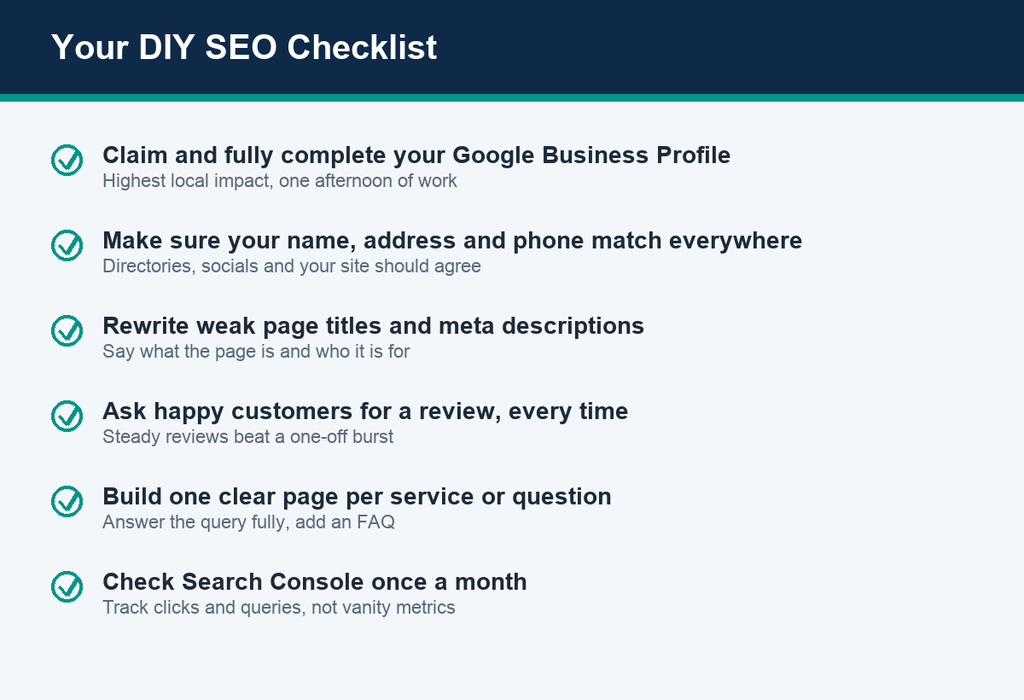
Six DIY wins you can start this week.
Earn links without buying them
Links from other websites still matter, but you do not need to pay for them, and you should not. Paid link schemes are risky and, frankly, a waste of money for a small business. The links that last are the ones you earn.
- Be a source. Journalists and bloggers constantly need quotes from real practitioners. Answering a query in your field can earn a link from a strong site for nothing but ten minutes of your time.
- Get involved locally. Sponsor a small event, join a local business group, or offer a genuine discount to a community organisation. These relationships often come with a natural mention and link.
- Partner sideways, not with competitors. A photographer and a florist, an accountant and a solicitor: complementary businesses can happily recommend and link to each other.
One relevant, genuinely earned link is worth more than fifty bought ones, and it will never come back to haunt you.
Measure what actually matters
It is easy to drown in dashboards. For a small business, three numbers tell you almost everything: how many people find you in search, which queries bring them, and how many of them get in touch.
Check Google Search Console once a month. Look at the queries you are appearing for, the pages getting clicks, and anything close to the first page but not quite there, because a small improvement to those often brings the fastest wins. Ignore vanity metrics; a thousand visitors who never enquire are worth less than ten who do.
Know when to hand it over
Doing your own SEO is completely realistic, but your time is not free. If you find yourself spending evenings wrestling with technical issues instead of doing the work you are actually paid for, it may be time to bring in help. A good digital marketing agency can take the technical and ongoing work off your plate so you can focus on your clients, and the right one will happily explain what they are doing rather than hide it behind jargon.
The point is not that you must do everything yourself forever. It is that you can make real progress today, for free, and make an informed decision later about what is worth handing over.
Frequently asked questions
How long does SEO take to work?
Expect early movement on local and low-competition terms within a few weeks, and more meaningful results over three to six months. Anyone promising page one in days is not being honest with you.
Do I need to blog every week?
No. A handful of genuinely useful pages that answer real customer questions will almost always outperform a stream of thin weekly posts.
Is SEO dead because of AI?
No. AI answers still draw on well-structured, trustworthy web pages, and being the clear, credible source is exactly what gets you cited. The fundamentals in this guide matter more than ever, not less.
Should I pay for links?
No. Paid link schemes carry real risk and rarely help a small business. Earn links through relationships, local involvement and being a useful source instead.
Can I really do SEO myself, or do I need an agency?
You can absolutely do the basics yourself, and you should start there. Consider an agency when the time you spend on SEO is costing you more than it would to hand it off.
The takeaway
SEO for a small business is not about outspending anyone. It is about doing the simple, unglamorous basics consistently while your competitors chase shortcuts. Complete your Google Business Profile, tidy your details, answer real questions on clear pages, earn a few honest links, and check your numbers once a month. Choose two or three wins from this guide, give them a season to work, and you will see the difference where it counts: in enquiries, not vanity metrics.